Webhooks
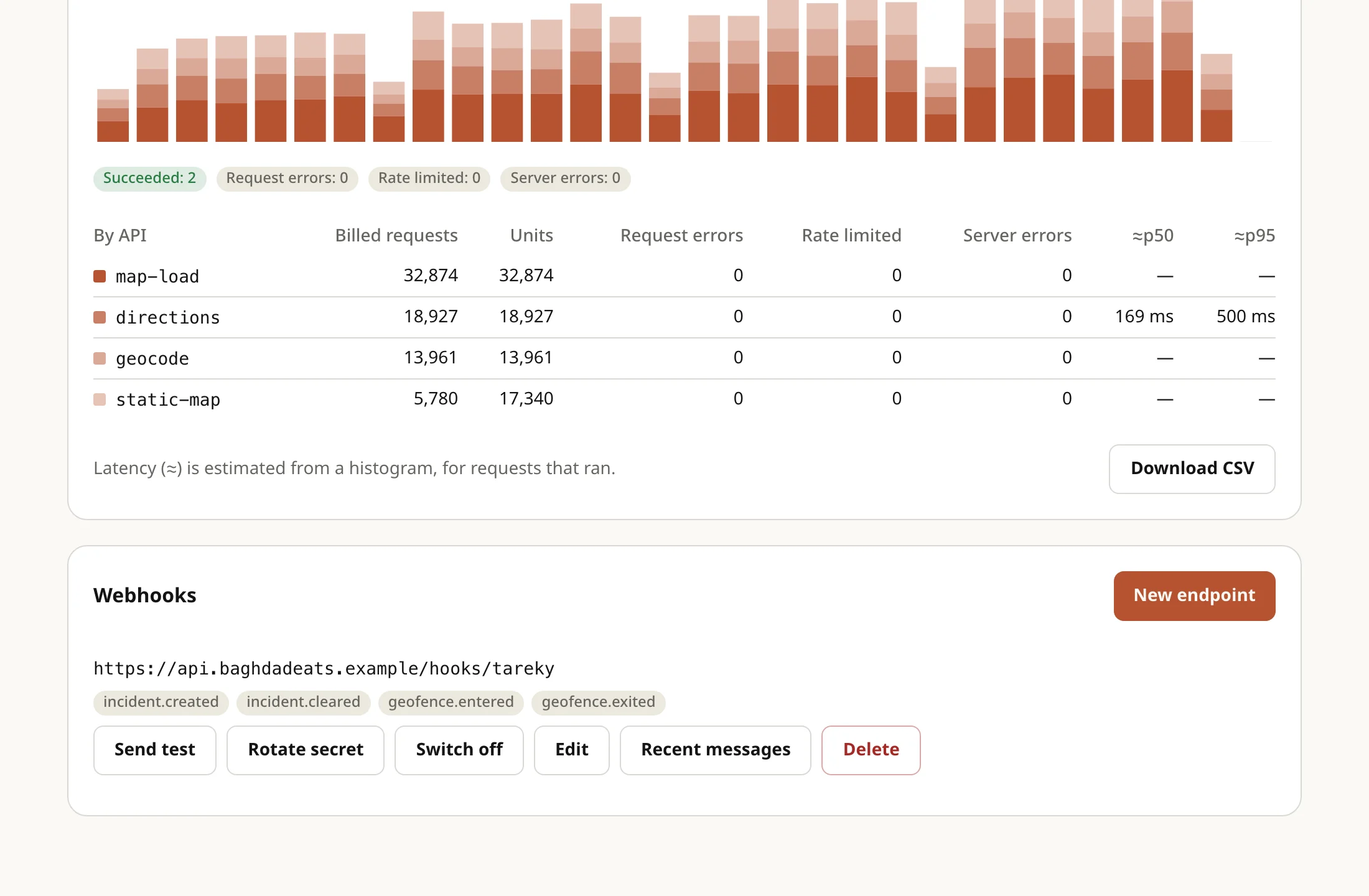
Register an HTTPS endpoint for your app in the console and we send it events as they happen. An app can have up to 5 endpoints.
Events
Section titled “Events”| Event | When |
|---|---|
incident.created, incident.updated, incident.cleared, incident.disputed |
A road report in your feed’s area |
feed.import.completed, feed.import.failed |
An import of the incident feed you publish |
geofence.entered, geofence.exited |
A device enters or leaves a geofence |
quota.threshold |
80% and 100% of the month’s units |
webhook.test |
The console’s test send |
Verifying the signature
Section titled “Verifying the signature”Messages are signed per Standard Webhooks, so their official libraries work:
import { Webhook } from 'standardwebhooks'
const wh = new Webhook(process.env.TAREKY_WEBHOOK_SECRET) // whsec_…const event = wh.verify(rawBody, { 'webhook-id': req.headers['webhook-id'], 'webhook-timestamp': req.headers['webhook-timestamp'], 'webhook-signature': req.headers['webhook-signature'],})- Verify the raw body, before parsing it as JSON.
- After you rotate the secret, messages carry signatures from both secrets for 24 hours.
webhook-idstays the same across retries and redeliveries: use it to drop duplicates.
Retries
Section titled “Retries”Answer 2xx within a few seconds. Otherwise we retry after 30 seconds, 2 minutes, 10 minutes, 30 minutes, 1 hour, 3 hours and 12 hours (8 attempts in all).
- Answering 410 Gone switches the endpoint off at once.
- An endpoint failing 5 days in a row is switched off.
- Switch it back on in the console, where you can also redeliver any past message.
We never deliver to internal or private addresses, and the address is checked on every send.